
Wednesday 10th June 2026
During our six days in Rwanda we covered around 635km, ate 16 meals (plus snacks 😉 ), slept in five different beds, met dozens of people, saw lots of animals, walked thousands of steps, and still probably only just scratched the surface.
Regardless, I’d still like to document a few observations, if only from a place of relative naivety.
The thing that obviously impressed me most about Rwanda is how the country has rebuilt itself following the 1994 genocide. The scars of that dark period are still obvious, but Rwanda has shown remarkable resilience in its efforts to heal and reconcile, and I think the country serves as a testament to the resilience of the human spirit and the power of forgiveness.
As a visitor, it is impossible not to be moved by the way Rwanda acknowledges its past while looking confidently towards the future. Everywhere we have visited, we have seen evidence of a country focused on reconciliation, community and progress. To us, the country appears clean, safe and welcoming, and there is a strong sense of pride among the people.
I didn’t really have high expectations, which I always think is useful. Our decision to go to Rwanda was more about convenience and getting to a new country, rather than because we had heard it was amazing.
It’s certainly not on most people’s bucket list, and the journey is not well travelled by Australians, with only around 3000 of the 1.5 million visitors each year being Australians. Although Australian visitor numbers are not significant, Rwanda has been one of Africa’s tourism success stories over the past decade, and growth has accelerated again since the pandemic.
Rwanda’s environmental success is seen as a bit of a masterclass in green governance. Known as the “Land of a Thousand Hills,” the country has transformed itself into one of Africa’s cleanest, greenest nations through positive policies and community action. A cornerstone of this success is Umuganda, a monthly nationwide community service day where citizens come together to plant trees, clean streets, and restore local infrastructure. This effort, combined with a pioneering ban on non-biodegradable plastics and single-use bags, has earned the capital city, Kigali, a reputation as one of the cleanest urban centres in Africa.
Beyond urban cleanliness, Rwanda is also considered strong in biodiversity conservation. Through the Rwanda Environment Management Authority (REMA) and community-led ecotourism initiatives, the country strives to protect its fragile ecosystems like the Akagera and Volcanoes National Park. Tourism revenue directly funds local communities and anti-poaching efforts, creating a sustainable loop that preserves endangered gorillas and rainforests.
Politically, things are interesting in Rwanda. Elections are not regarded as ‘free or fair’, but despite this there appeared very strong support for President Paul Kagame and his government. The government appears to use quite a firm hand, and citizens appear to be very compliant. Crime rates are low, there is minimal drug use, very few drink driving charges (because of a zero-alcohol rule) and as I mentioned, the whole country gets involved in a clean-up day each month. Whether that compliance is a result of fear, a history of extreme violence or simply the impact of past traumas (or a mixture of all those things), I’m not quite sure, but the day-to-day lives and health of the population does appear to be improving (and the life expectancy is improving dramatically), although all these improvements are potentially at the expense of some freedoms.
Visiting Rwanda has certainly reminded me that even after unimaginable tragedy, resilience, unity and hope can create a positive path forward.
FOOD AND NUTRITION
Given my interest in food – I thought documenting some information on the Rwandan diet would be helpful. Rwandans generally consume a high-fibre, plant-based diet of staples like beans, sweet potatoes, cassava, plantains and bananas. In fact, Rwanda boasts one of the highest per-capita bean consumption rates globally,
While healthy, it relies heavily on plant-based staples, meaning their diet often lacks dietary diversity and sufficient protein, leading to malnutrition and rising obesity in urban areas. The reliance on starches creates significant challenges for childhood nutrition, as a lack of diversity and minimal animal protein leads to high rates of chronic malnutrition and stunting in young children.
On a positive note, there is very little fast food, and it was uncommon for us to see fried food on menus. There is one KFC in Kigali, but no McDonalds or Burger King (much to Dave’s disappointment!)
When comparing food costs from country to country as we travel, I often use McDonalds as a benchmark, but with no Maccas in the country, we couldn’t do that. I can say that all our meals were very good value. Coffee was usually about $3 for a cappuccino, our lunch of beef and mushrooms (me) and omelette (Dave) was about $7 each (including a drink) and even the Chinese meals we had in the hotel restaurant were only around $12 each.
CAPE TOWN
We are now in Cape Town.
On Saturday afternoon we received a phone message from Rwanda airlines that our flight to Johannesberg would be delayed. The message said it would now leave at 10:30am, which was very odd considering we were already scheduled to leave at 10:30am!
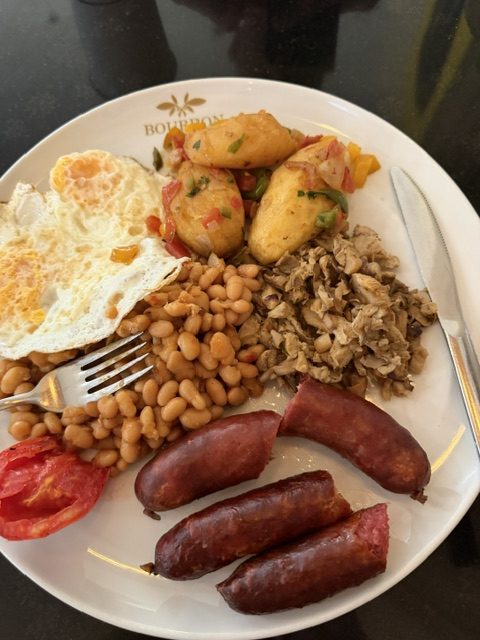
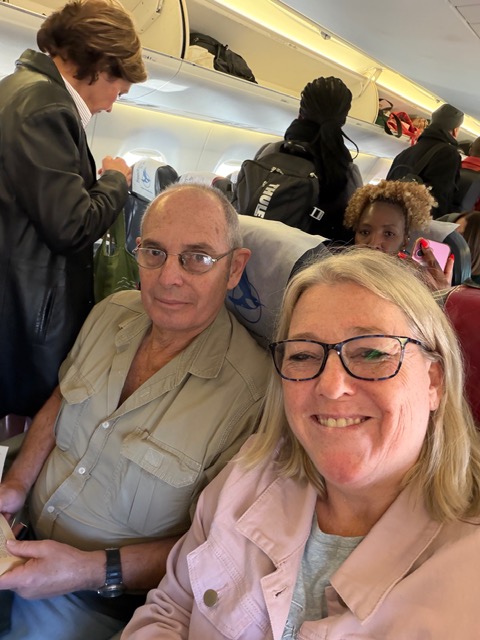
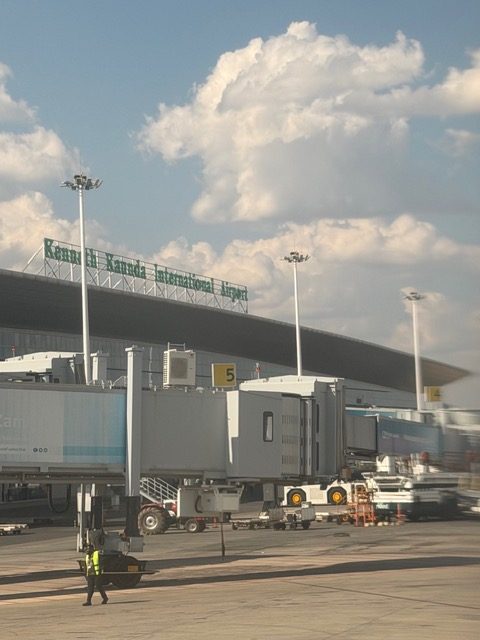
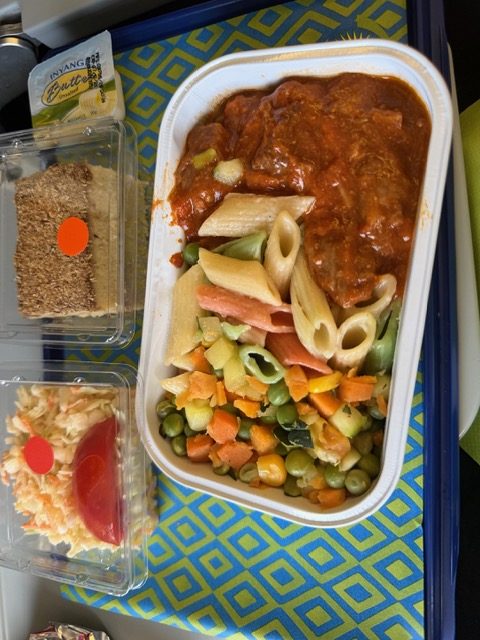
In the early hours of Sunday morning, we received another email, this time saying that our flight would now depart at 11:30am and the plane would travel via Lusaka (the capital of Zambia). Unfortunately, our airport transfer was already booked for 7am, and with very little traffic on a Sunday morning, we were at the airport rather earlier than needed. The queue to check in was reasonably long and I was a touch ‘hangry’ when we finally passed through security and ordered our breakfast at the only cafe in the airport.
Rather than ordering something I liked, I ordered something I thought would be big, but I only ended up eating the eggs and the beans. I can’t even tell you what some of the items on the plate were!
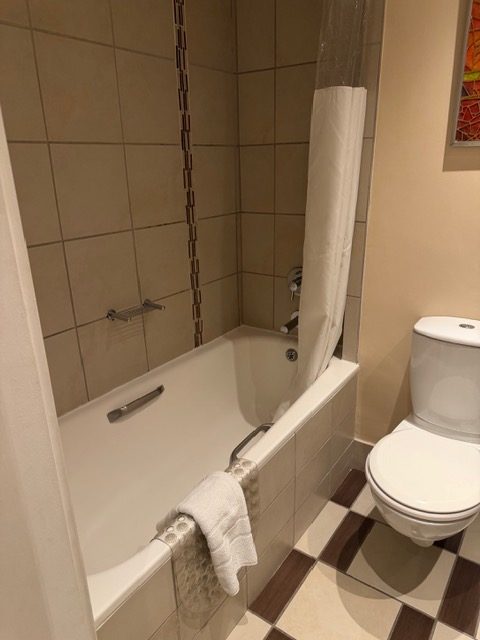
We ended up arriving in Johannesburg around 5pm and stayed Sunday night at a hotel close to the airport. Two of Dave’s shamwaris (friends) from the 1970’s met us for dinner at the in-house Irish Pub style restaurant. They were both lovely and really interesting to talk to, and even better, the lasagne I ordered was excellent. Not really Irish but was just what I felt like.
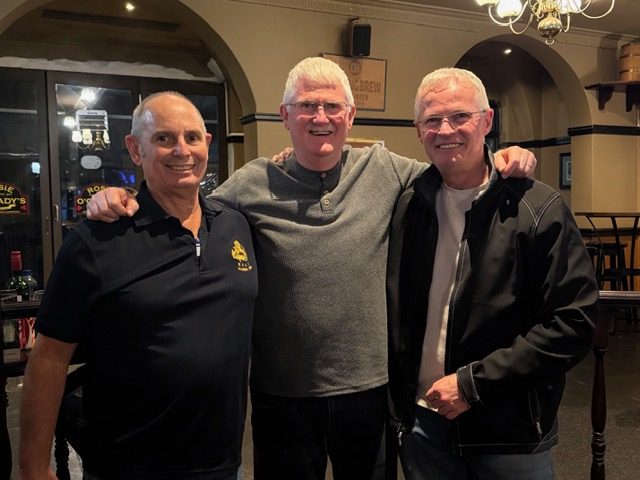
After breakfast on Monday morning, we caught the shuttle back to the airport for our midday flight to Cape Town. It’s a two-hour flight and the fog was just starting to come down as we landed. I really like Cape Town. It has lots of fabulous things to see and do, the scenery is just stunning (especially Table Mountain) and it has an excellent food scene. If you are a foodie like me, you must visit Cape Town if you can.
I’d booked to go to ‘Chef’s Warehouse and Canteen‘ for dinner on Monday. It was a short walk from our hotel, although CT is not the safest place, so we walked watchfully and quickly!

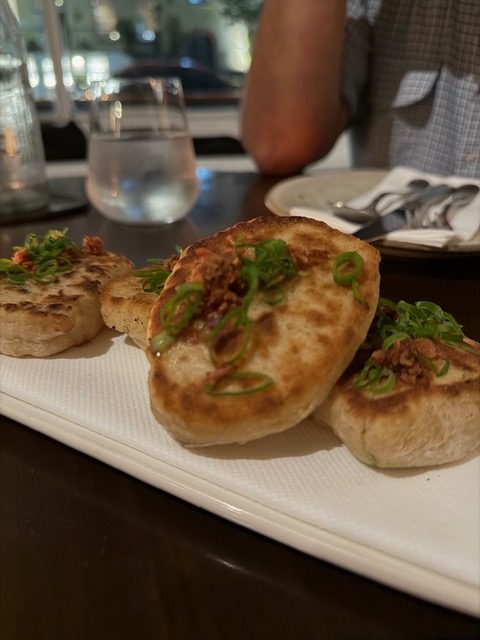

Dinner was fabulous. It is tapas style and I ordered grilled bread, Tomato Tarte Tartin, a very (very) delicious Japanese Grilled Cabbage, Miso Chicken skewers and Lamb Ragout with Polenta. The cabbage was particularly good and I’m still thinking about it. I will attempt to replicate it when I get home!
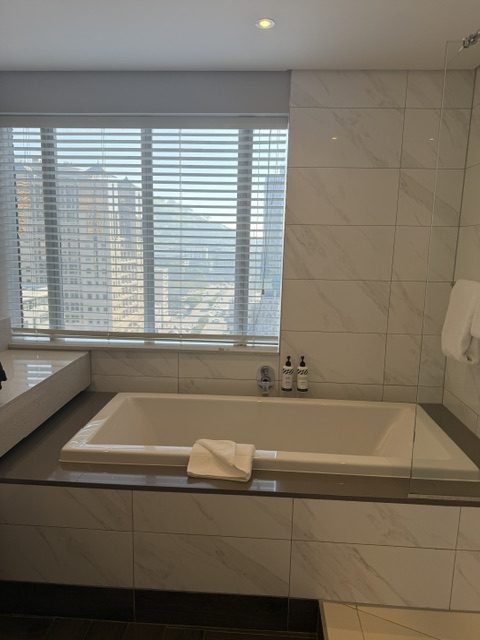
Another careful walk back to the hotel then a very long soak in the lovely deep bathtub that has a view over CT. Delightful!
I’ll save the rest of our Cape Town goings-on for the next post, which I’ll probably type from the cruise ship.
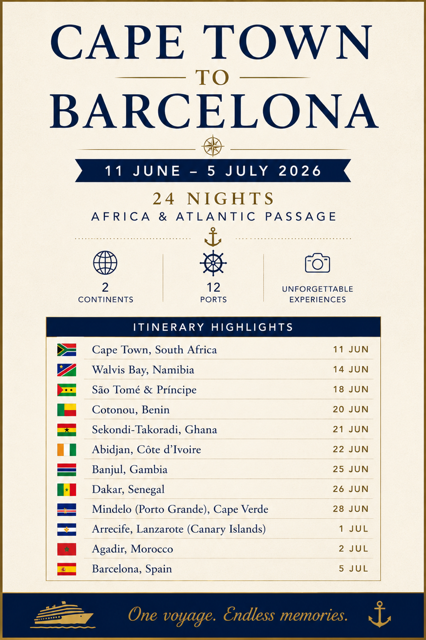
Yes, tomorrow we leave for a 24-day cruise up the west coast of Africa.
Trip of a lifetime? Most definitely!
Such a great read Sara – your trip is amazing. Loved learning about Rwanda. What and adventure!
Will be great to catch up when we are home and swap travel stories!
I love your brave and inquisitive travelling style! The trip so far has been great, and the cruise looks amazing!
☺️