
SATURDAY 20th JUNE 2026
If you have been following out itinerary, you would have expected to be reading about our stop in São Tomé.
Unfortunately, the swells were too big, and the captain decided after a few tries that it was too dangerous to use the tenders to take us ashore. He obviously didn’t take into account Dave’s and my enjoyment for a bit of risk taking… but I guess he hasn’t got to know us 😉
What this meant was five straight days at sea. Possibly a bit more that I would normally like, but being at sea on a beautiful ship such as this is actually not too much of a punishment! It’s a bit like retirement for me; it took a moment or two to slow down and appreciate the time and space, but once you get into it, it’s rather nice!
This morning we docked at 6am in Cotonou, the economic centre of Benin. It’s a busy port city and it was interesting to be up early and watching the port come to life as we carefully docked between two cargo vessels.
Many of the tours on the cruise are free. We chose the one that took us to Porto-Novo, the country’s official capital and a city rich in history and culture. I’m assuming, like me, you know very little about Benin, and in the short time we had here we did get a bit of a glimpse into the goings-on of the Benin people. Benin has an interesting past and is a unique blend of African, Brazilian, European and particularly French influences.
Benin was once part of the powerful Kingdom of Dahomey, one of West Africa’s most influential kingdoms between the 17th and 19th centuries. Porto-Novo became an important trading centre and later served as the capital of French Dahomey before the country gained independence in 1960. They do continue to speak French however, so my four years of high school French classes came in handy!
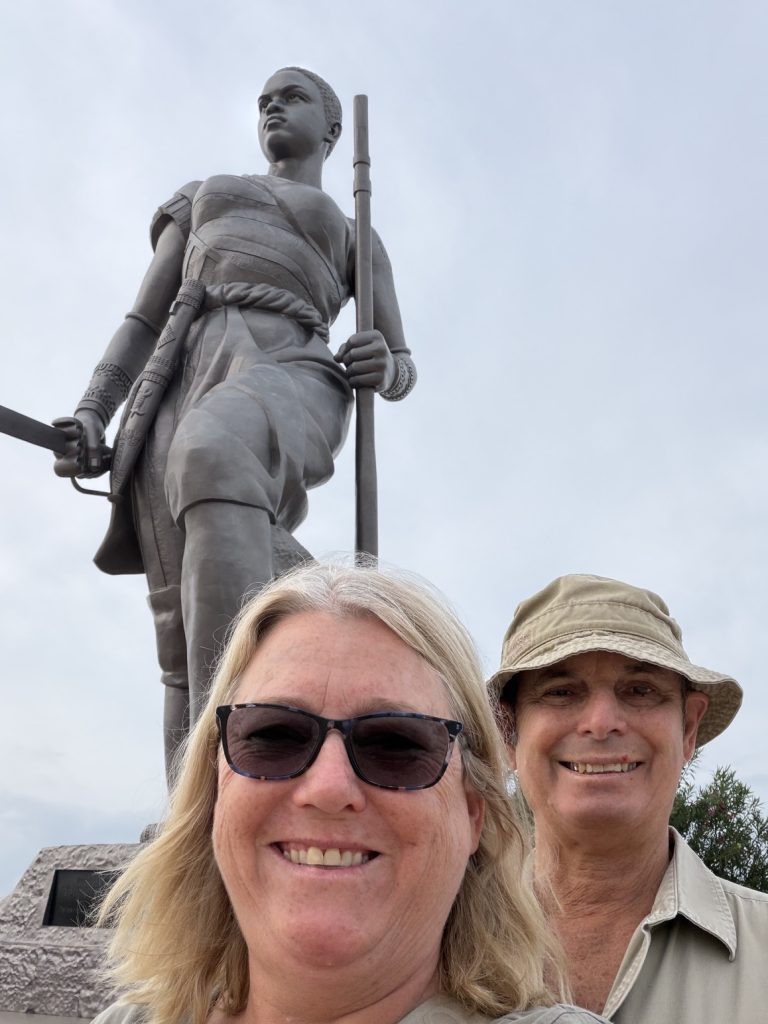
We boarded a bus at the port with around 25 others and headed firstly to a nearby very large (30m) bronze statue of a fighting woman, honouring the 800 strong women’s elite fighting battalion in the 1700 and 1800s. We then drove about an hour to Porto-Novo, where we saw some live dancing and explored the relics of the old royal palace, which offers a glimpse into the region’s royal heritage. I’m not one for looking at old relics like this and nor is Dave. The tourism industry here is in its infancy and I’m sure that’s why our guide felt like he needed to share every piece of information he had ever learned and all in a very (very) loud voice! A young American man in our group who felt the need to ask senseless questions and reiterate everything the guide said in his own words added to my irritation. Combined with a headache, 95% humidity and 30C, it made for a slightly grumpy Sara 😉
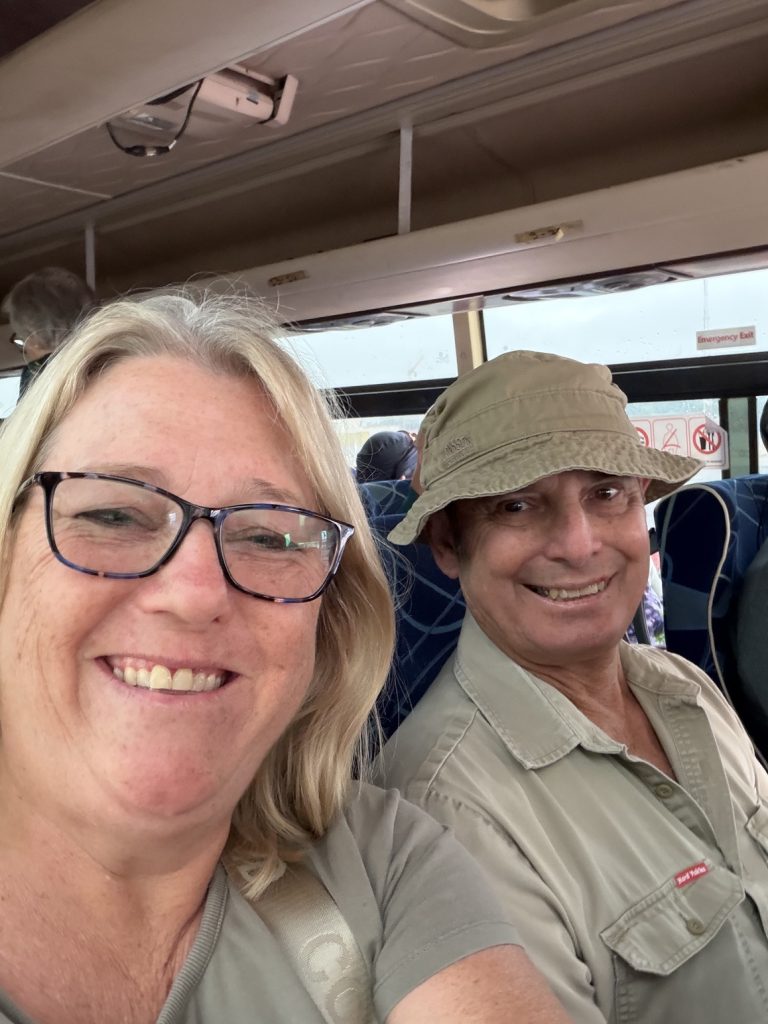

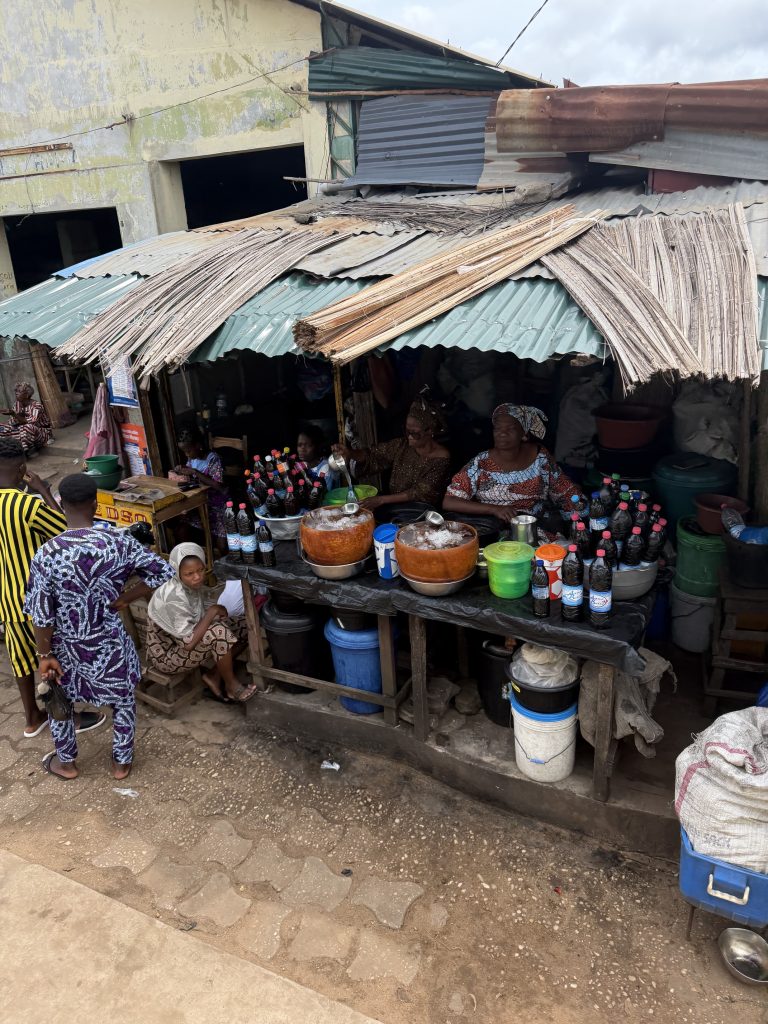
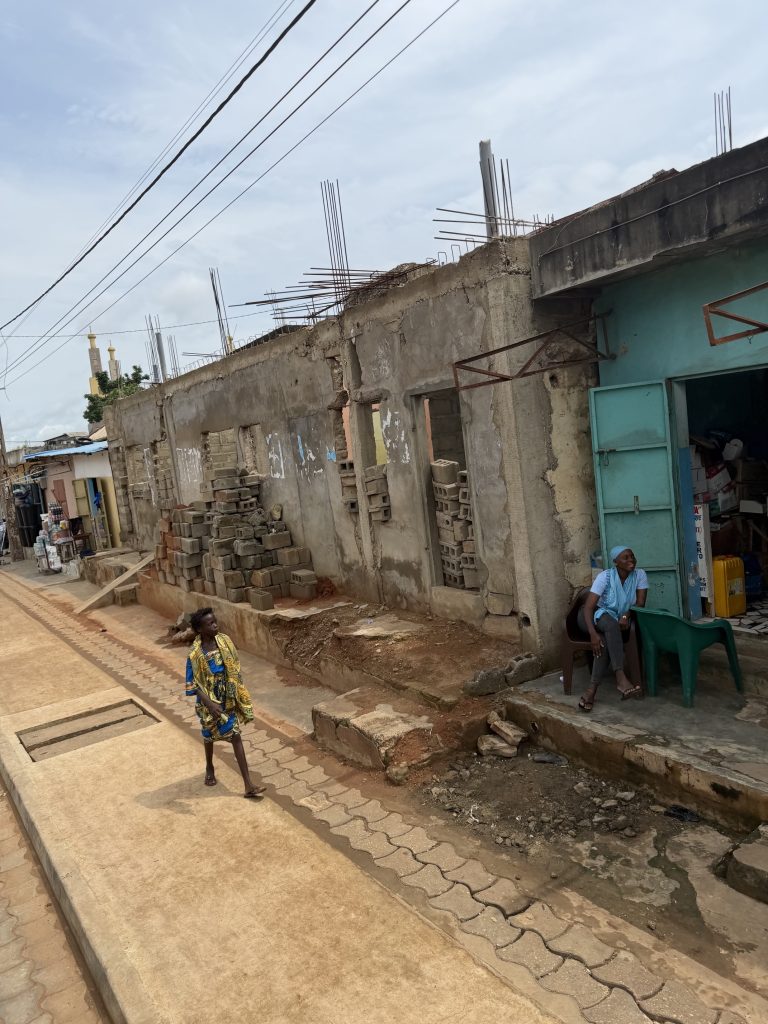

I did however really love the drive through the streets and the scenes we got from the air-conditioned bus. So, so many cute kids, colourful dresses, interesting cars and when we pulled up outside a market to go and look at a mosque, we decided to stay on the bus and it was great to watch all the market business, which on a Saturday was pretty hectic.
While we didn’t see inside the mosque, it was interesting to hear from our guide about how the country’s religious diversity, where Christianity, Islam and the traditional religion of Voodoo, coexist peacefully. I think the world could learn something about that! Benin is actually the home of Voodoo.
One of the things we particularly noticed was how many children there were. Being a Saturday, families and young people were out and about, and the streets were full of life. Benin has a remarkably young population, with nearly half of all residents under 15 years old. The country’s population is growing quickly (as opposed to Australia’s which is ageing), creating a vibrant and energetic atmosphere, with lots of kids smiling and waving at us!
Benin has long been considered one of West Africa’s more stable democracies, although recently this has declined, even seeing a coup attempt late last year. Life expectancy is improving, although diseases such as Malaria are still common. In fact, Malaria is the leading cause of death, followed by respiratory infections (e.g. pneumonia) and stroke.
In Australia, most people die from diseases associated with old age, with life expectancy about 83 years. In Benin, where life expectancy is around 61, infectious diseases remain the biggest killers. At 61, it still falls below the African average of 64, and from what we saw living conditions appeared pretty basic. I’ve done a bit of research into relative life expectancies – I think it’s a pretty good guide to assess how a country is fairing.
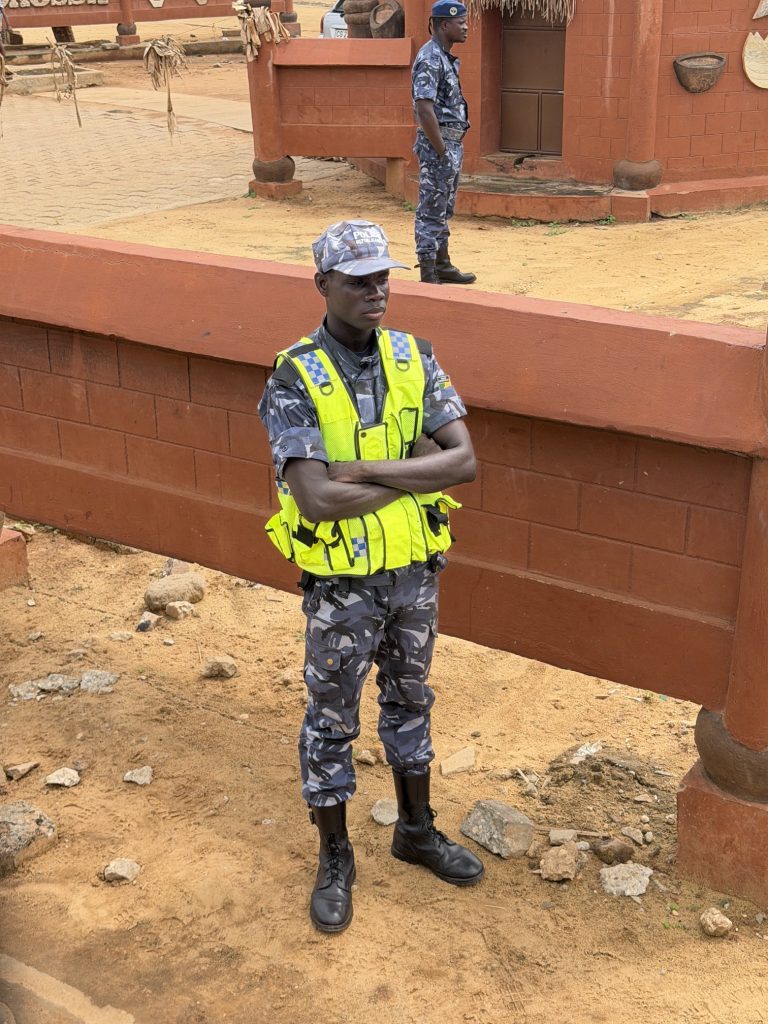
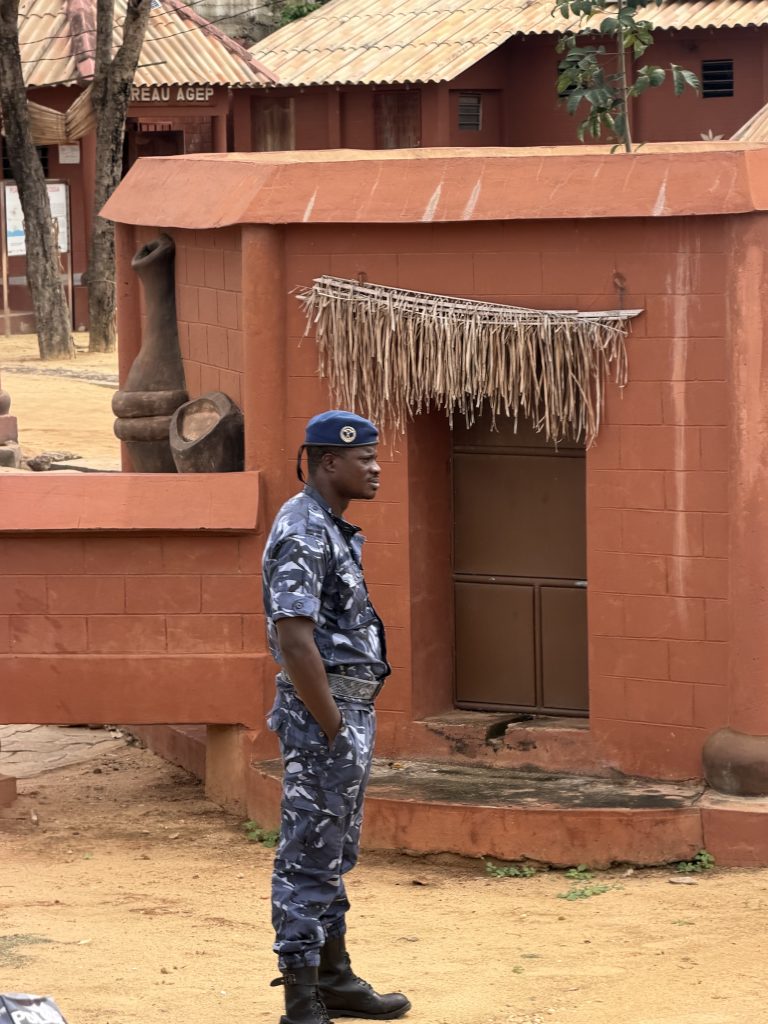
This is a reasonably small ship, so there were only nine buses going on tours. Most people take tours as many of them are free. It was interesting that each bus had a police escort. I’m not sure if that’s because there is an issue with security, or because a ship visiting here is reasonably rare and they wanted to make a good impression.
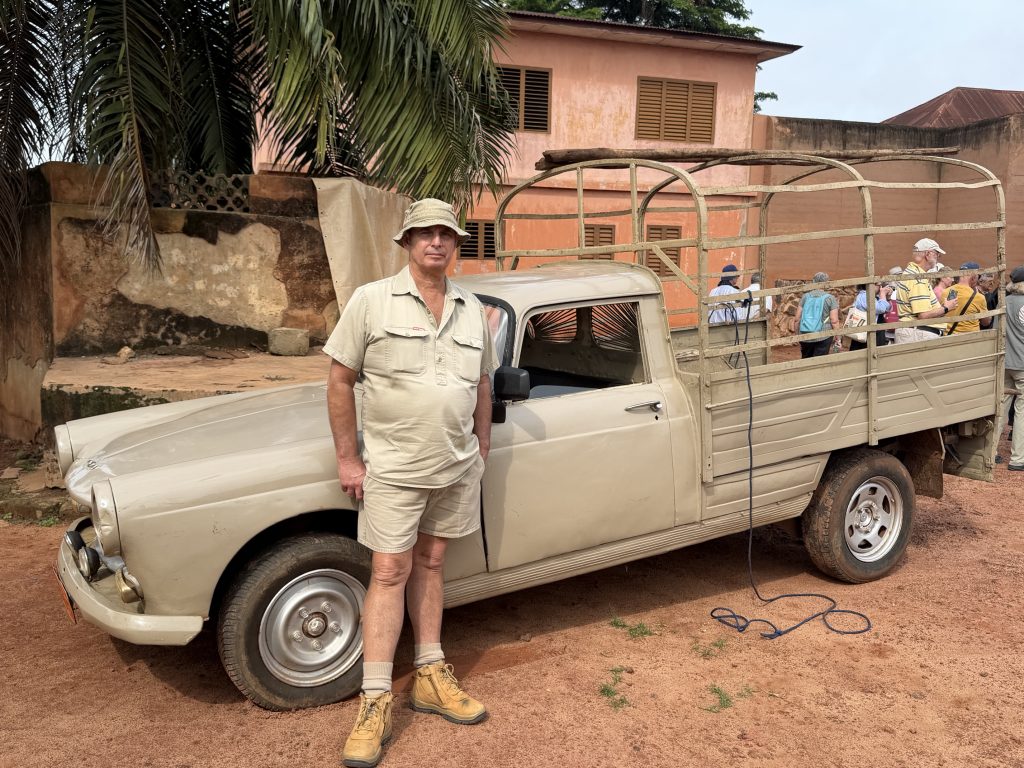
While we didn’t love the tour, it was good to see a small slice of Benin. Our favourite fun fact of the day being how many old Peugeots there were! If Australia has Toyota Hilux’s, Benin has Peugeots. Dave was particularly enamoured with the numerous Peugeot 404 pickups – I couldn’t find any stats but apparently Benin is something of a legend among Peugeot enthusiasts.
We are now back on the ship, and with everyone back on board ahead of schedule, we departed early at 3pm to head to our next port. The swell is up and the captain has put the stabilizers out – it should be a fun night of rocking and rolling!
Tomorrow, we arrive in Sekondi-Takoradi, in Ghana. I’ve just discovered that there is a railway museum there. I’m not sure if I should mention it to Dave or not ( 😉 😉 ), but potentially Dave will be keen to skip the bus trip tomorrow and take that in, instead?
I’ll let you know tomorrow!
Sara xx
I would like to go to Africa, Ghana especially, but I am really no good in the humidity! I’m also not a fan of pointless questions on a tour!
I probably get irritated by it more than I should Amy – I do believe that there are sometimes stupid questions 😉